
Table of Contents
H1: Best IPTV Providers: The Ultimate Guide to Professional IPTV Encoders for Sale in 2026
The Emotional Connection
Imagine this: You’ve spent weeks curating the perfect channel lineup and building a sleek interface, only for your stream to lag, pixelate, or crash during the championship game. The frustration isn’t just yours—it belongs to every subscriber you’ve worked so hard to gain. In the world of high-stakes streaming, your content is only as good as the hardware pushing it. Whether you are scaling a commercial venture or building a bulletproof home system, choosing the right encoder is the difference between a “buffering” nightmare and a broadcast-quality dream. Today, we’re stripping away the jargon to help you find the best IPTV encoders for sale that will make you the gold standard among IPTV providers.
H2: Understanding the Core: What Are IPTV Encoders?
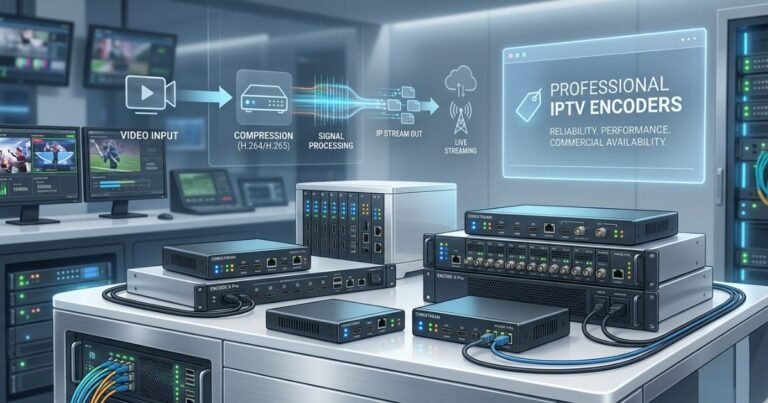
At its most basic level, an IPTV encoder is a dedicated piece of hardware that takes a raw video signal—usually via HDMI or SDI—and “translates” it into a digital format that can travel across the internet. In 2026, this translation is more complex than ever. It involves compressing massive video files into lean, data-efficient streams like RTMP, UDP, or HLS without losing that crisp, “live” feel.
If you want to be recognized as one of the top IPTV providers, you cannot rely on standard PC software to do this heavy lifting. Hardware encoders use dedicated chips (ASICs) designed specifically for video processing. This means they don’t get distracted by background updates or OS crashes. They do one thing, and they do it with surgical precision.
H2: Why Top-Tier IPTV Providers Invest in Dedicated Hardware
You might wonder why you should shell out hundreds or thousands of dollars for a box when software like OBS exists for free. The answer lies in the three pillars of professional broadcasting: Reliability, Efficiency, and Scalability.
H3: The Reliability Factor
Software-based encoding is prone to “jitter” and system fatigue. A hardware encoder is a “set it and forget it” solution. Once configured, it can run for months without a reboot, providing the 99.9% uptime that modern subscribers demand.
H3: Efficiency and Bandwidth Savings
Modern encoders for sale in 2026 prioritize the H.265 (HEVC) codec. This technology allows you to stream 4K content using nearly half the bandwidth required by older H.264 systems. For you, this means lower CDN (Content Delivery Network) costs. For your viewers, it means a buffer-free experience even on mediocre internet connections.
H3: Scalability for Business Growth
As your brand grows, you’ll move from streaming a single feed to managing dozens. Professional rack-mount encoders allow you to house 4, 8, or even 16 encoding modules in a single unit. This high-density setup is exactly how the biggest IPTV providers manage international channel lists without filling an entire room with noisy PC towers.
H2: Comparing the Best IPTV Encoders for Sale in 2026
The market is flooded with options, but for a professional setup, you should look at brands that have proven their mettle in 24/7 environments.
H3: Top Hardware Picks for Professionals
- Magewell Ultra Encode AIO: This is the “Swiss Army Knife” of encoders. It supports both HDMI and SDI, making it perfect if you’re transitioning from consumer gear to pro-grade cameras.
- Teradek VidiU Go: If your streaming setup is on the move—think live sports or on-location reporting—this is your best bet. It features “network bonding,” which combines multiple internet sources (like Wi-Fi and 5G) into one unbreakable stream.
- VeCASTER Pro 4K: This is a powerhouse for fixed installations. It’s designed specifically for the IPTV market, offering direct support for the protocols used by major middleware panels.
H4: Comparison Table: Tech Specs & Pricing
| Feature | Magewell Ultra Encode AIO | Teradek VidiU Go | VeCASTER Pro 4K |
| Max Resolution | 4K @ 60FPS | 1080p @ 60FPS | 4K @ 30FPS |
| Compression | H.264 / H.265 / NDI | H.264 / HEVC | H.264 / H.265 |
| Primary Input | HDMI & SDI | HDMI / USB (Modems) | HDMI |
| Network Bonding | No (Single Source) | Yes (ShareLink) | No |
| Best For | Professional Studios | Mobile/Live Events | 24/7 Distribution |
| Approx. Price | $899 | $795 | $549 |
H2: H.264 vs. H.265: Which Encoding Standard Should You Buy?
When browsing IPTV encoders for sale, you’ll see these two terms constantly. Here is the breakdown:
- H.264 (AVC): The “Old Reliable.” It works on every device, from 2010 smart TVs to the cheapest Android boxes. However, it is a bandwidth hog.
- H.265 (HEVC): The “Future.” It is the standard for 4K. It provides significantly sharper images and handles high-motion scenes (like football or action movies) with far fewer “blocks” or artifacts.
Why you should choose H.265:
- Reduced Bandwidth: Stream 1080p at 2Mbps instead of 4Mbps.
- Better 4K Support: Essential if you want to market yourself as a premium provider.
- Mobile Friendly: Viewers on limited data plans will thank you for the lower consumption.
H2: How to Set Up Your New Encoder (Step-by-Step)
Setting up professional hardware doesn’t have to be a headache. Follow these steps to get your stream live:
- Physical Connection: Connect your video source (Camera, Media Player, or PC) to the HDMI/SDI input. Connect an Ethernet cable from your router to the encoder.
- Find the IP Address: Most encoders have a small OLED screen or a mobile app to show their IP address. Type this into your computer’s web browser.
- Configure Video Settings: Set your resolution (e.g., 1920×1080) and choose your codec (H.265 is recommended for 2026).
- Enter Stream Credentials: Copy the RTMP URL and Stream Key from your IPTV provider dashboard or middleware.
- Test and Monitor: Use the “Preview” function to ensure your audio and video are in sync before pushing to your full subscriber base.
H2: FAQ: What Every IPTV Provider Needs to Know
Q: Can I use these encoders with all IPTV providers?
A: Absolutely. Most professional hardware encoders output universal protocols like RTMP, SRT, and HLS, which are the industry standard for all major IPTV providers and streaming panels.
Q: Is it worth buying a used encoder?
A: While tempting, be careful. Older models often lack H.265 support or have outdated security protocols. In 2026, a modern, mid-range encoder is almost always better than a 5-year-old “flagship” model.
Q: Do I need a static IP address for my encoder?
A: It isn’t strictly required, but it makes management much easier. A static IP ensures you can always find your encoder’s dashboard on your network without hunting for it every time the power cycles.
H2: Conclusion: Elevating Your Streaming Game
The landscape of digital media is more competitive than ever. As the demand for high-definition, lag-free content grows, your choice of hardware becomes your strongest marketing tool. By investing in the right IPTV encoders for sale, you aren’t just buying a box; you’re buying the trust of your audience and the stability of your brand.
Whether you opt for the versatility of Magewell or the rugged mobility of Teradek, the goal remains the same: deliver excellence. Don’t let a “buffering” wheel be the reason your subscribers leave. Upgrade your infrastructure today and join the ranks of the world’s most reliable IPTV providers.
Ready to transform your stream? Browse our latest selection of professional encoders and take the first step toward a broadcast-quality future!