
Table of Contents
Introduction: Why Your Streaming Quality Depends on One Critical Decision
In today’s digital world, video content dominates everything from entertainment to education, marketing, and corporate communications. No matter what kind of content you produce—whether live sports, premium TV channels, educational courses, or entertainment streams—the success of your delivery depends on one crucial factor: the quality of your streaming. Viewers expect instant playback, high-definition visuals, and smooth performance without buffering or delays. If your streams fail to meet these expectations, users won’t wait or complain—they’ll leave, and they may never return. This is why selecting the right IPTV encoder is one of the most important decisions you will make in your streaming journey.
What Is an IPTV Encoder?
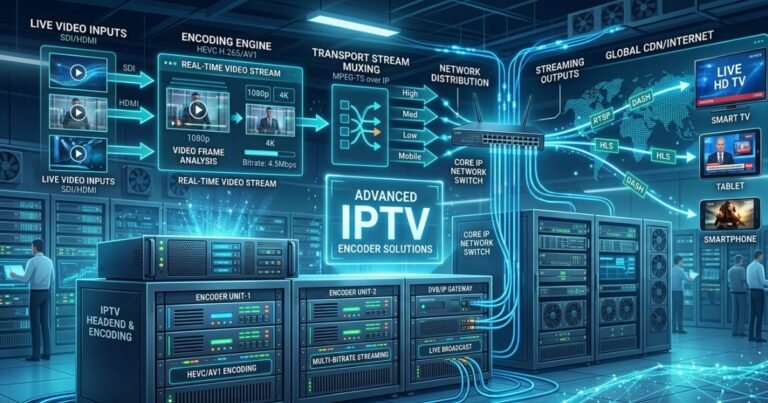
An IPTV encoder is a system—hardware, software, or cloud-based—that converts raw video signals into digital streams suitable for transmission over IP networks. Without an encoder, your video cannot be efficiently streamed over the internet, as raw video files are extremely large and can overwhelm bandwidth, causing buffering and poor playback quality. Essentially, the encoder compresses and formats your video so it can reach viewers in a smooth, high-quality stream.
The encoding process typically involves several key steps. First, the video input is captured from sources such as cameras, satellite receivers, media players, or live production systems. Next, the encoder compresses the video using codecs like H.264 or H.265 to reduce the file size without sacrificing visual quality. After compression, the encoder converts the video into a digital format compatible with streaming protocols such as HLS, RTMP, or MPEG-TS. Finally, the stream is delivered to viewers’ devices, which can include smart TVs, mobile devices, IPTV set-top boxes, or web browsers. Each step in this process is critical because any inefficiency can result in buffering, lag, or degraded quality.
Types of IPTV Encoder Solutions
IPTV encoders come in three primary forms: hardware, software, and cloud-based solutions. Each has its advantages, limitations, and ideal use cases, so understanding the differences is key to making the right choice.
Hardware IPTV encoders are dedicated physical devices built specifically for encoding video streams. They use specialized chips to process video efficiently, making them highly reliable and stable for continuous 24/7 streaming. Hardware encoders offer low latency, consistent performance, and independence from computer resources. This makes them the preferred choice for professional broadcasters, television networks, and large-scale IPTV services. The main drawback of hardware encoders is their high initial cost and lower flexibility compared to software or cloud solutions, as they require physical setup and maintenance.
Software IPTV encoders, on the other hand, are applications installed on computers or servers. They offer affordability and flexibility, making them an excellent choice for startups, small IPTV services, and individual content creators. Software encoders can handle multiple streams and formats, but they rely heavily on the computer’s CPU and GPU. Under heavy workloads, performance may decline, and system optimization becomes critical to ensure smooth streaming.
Cloud-based IPTV encoders represent the latest evolution in streaming technology. These services run entirely online, eliminating the need for physical hardware or local software installations. Cloud encoders allow for instant scalability, global accessibility, and automatic updates. They are ideal for OTT platforms, rapidly growing streaming services, or businesses requiring flexible, reliable streaming infrastructure. However, cloud solutions depend on internet quality and come with ongoing subscription costs.
Choosing the right type of encoder depends on your specific requirements, including budget, scale, and the number of channels you plan to stream.
Key Features to Look for in an IPTV Encoder
When selecting an IPTV encoder, certain features are essential for ensuring smooth, high-quality streaming. Video compression technology is the first and most critical consideration. Modern encoders use codecs such as H.264 (AVC) and H.265 (HEVC). H.264 is widely supported and delivers good quality but requires more bandwidth, whereas H.265 is more advanced, maintaining high visual quality while using up to 50% less bandwidth. Selecting the right codec can significantly reduce operational costs without compromising user experience.
Input and output support is another essential factor. Your encoder should be compatible with all the video sources you plan to use, including HDMI for consumer devices, SDI for professional broadcast equipment, and IP streams for digital sources. On the output side, the encoder must support streaming protocols like HLS for adaptive streaming, RTMP for live streaming platforms, and UDP/RTP for ultra-low latency scenarios. These capabilities ensure your streams can reach a wide variety of devices and audiences efficiently.
Bitrate control and adaptive streaming are also critical. High-performance encoders allow you to manage both constant bitrate (CBR) and variable bitrate (VBR) streaming. Adaptive bitrate streaming automatically adjusts video quality based on the viewer’s network conditions, ensuring smooth playback even on slower connections. Latency optimization is equally important, especially for live sports, interactive events, and gaming streams. A good encoder minimizes the delay between the source and the viewer’s screen, delivering a seamless live experience.
Finally, multi-channel encoding and scalability allow you to stream multiple channels simultaneously at different resolutions, such as SD, HD, or 4K. As your audience grows, a scalable encoder ensures your system can expand without performance degradation, keeping your service professional and reliable.
Benefits of IPTV Encoder Solutions
Investing in a quality IPTV encoder delivers several benefits. First and foremost, it ensures superior video quality. High-definition and 4K streaming are achievable, creating a professional viewing experience that keeps audiences engaged. Smooth, uninterrupted streams help maintain user satisfaction, loyalty, and retention.
Second, encoders reduce operational costs by optimizing bandwidth usage and lowering infrastructure expenses. Switching to advanced compression methods like H.265 can cut bandwidth requirements in half, which translates into significant savings for large-scale streaming services.
Third, IPTV encoders enhance scalability. As your audience or number of channels grows, your streaming infrastructure can expand efficiently without requiring a complete system overhaul. Additionally, IPTV enables global reach, allowing you to deliver content anywhere in the world without the constraints of traditional broadcasting.
IPTV Encoder Use Cases
IPTV encoders are versatile and applicable across multiple industries. In broadcasting, traditional TV networks use encoders to transition from cable or satellite to digital IPTV platforms, expanding their reach while maintaining quality. Corporate environments rely on encoders for internal communication, training sessions, live announcements, and webinars. In education, encoders power online courses and virtual classrooms, delivering high-quality video lectures to remote students. Finally, OTT platforms such as video-on-demand services depend heavily on robust encoding solutions to deliver seamless, professional-quality streams to large audiences.
How to Choose the Right IPTV Encoder
Choosing the right encoder requires careful consideration. Start by identifying your streaming goals. Are you primarily offering live streaming or video-on-demand? What resolution and quality do you need? How many users do you expect at peak times? Understanding these factors will help narrow your options.
Next, evaluate your budget. Consider both initial costs and long-term operational expenses, including maintenance, electricity, and scalability. Always test potential solutions before committing. Trial runs allow you to monitor performance, measure stability, and ensure the system meets your expectations. Additionally, check compatibility with existing infrastructure, including IPTV middleware, CDN providers, and streaming platforms.
Finally, consider the long-term potential of the encoder. Technology evolves rapidly, and your solution should support future formats, higher resolutions, and larger audiences. Investing in a future-proof encoder ensures your streaming service remains competitive.
Common Challenges and Solutions
Streaming can come with challenges, but they are manageable with the right strategies. High bandwidth usage can be addressed with advanced compression methods like H.265 combined with adaptive bitrate streaming. Buffering or lag issues often result from suboptimal protocols or network constraints; optimizing bitrate and leveraging CDNs can dramatically improve performance. System instability or crashes can be mitigated by choosing reliable hardware or cloud-based encoders, ensuring consistent uptime and reliability.
IPTV Encoder Setup Guide
Setting up an IPTV encoder involves several key steps. First, connect your video source, whether it is a camera, media player, or live production feed. Next, configure your encoder settings, including resolution, bitrate, codec, and streaming protocol. Then, connect the encoder to your IPTV server or CDN. Once live, monitor performance continuously to ensure smooth streaming. Pro tips for optimization include using a CDN to improve global delivery, dynamically adjusting bitrate to match network conditions, and maintaining backup systems to prevent downtime during critical events.
Future Trends in IPTV Encoding
The IPTV landscape is evolving rapidly. AI-powered encoding is becoming increasingly common, automatically optimizing bitrate, resolution, and performance in real time. 4K and 8K streaming are no longer niche; demand for ultra-high-definition content is growing across entertainment, education, and corporate streaming. Cloud-based encoding solutions are also gaining dominance, providing scalable, flexible, and globally accessible infrastructure that eliminates much of the complexity of traditional hardware setups. Investing in solutions aligned with these trends will future-proof your service and keep you competitive.
Frequently Asked Questions (FAQ)
An IPTV encoder is a system that converts raw video into a digital stream suitable for online delivery. Software encoders are ideal for beginners due to their affordability and ease of use, whereas hardware encoders suit professional broadcasters. Modern IPTV encoders fully support 4K streaming, and advanced options even handle multiple channels and adaptive streaming. The difference between an encoder and a transcoder is that an encoder converts raw video for streaming, while a transcoder converts video between formats. Costs vary widely depending on the solution type, ranging from affordable software to high-end hardware or subscription-based cloud services.
Conclusion: Build a Strong Streaming Foundation
Your IPTV encoder is the cornerstone of your streaming success. Choosing the right solution ensures high-quality content delivery, cost optimization, scalability, and long-term growth. Ignoring this decision can lead to poor user experience, high costs, and limited growth potential. By carefully evaluating your needs, testing potential encoders, and considering future trends, you can build a professional, reliable streaming platform that keeps your audience engaged and satisfied.
Call to Action
Now is the time to take action. Evaluate your current streaming setup and ask yourself: Are you delivering the best quality possible? Is your system scalable? Are you ready for future demand? Start testing IPTV encoder solutions today. Compare features, monitor performance, and upgrade your infrastructure to ensure your audience receives the high-quality experience they deserve. The future of streaming waits for no one—make sure you deliver excellence today.